Merry Christmas and a Happy New Year to one and all on this Solemnity of Mary, the Mother of God!
Pardon my lack of blogging in the last week, but I was on vacation back home and didn't want to take away from my limited time with my family.
I do have a short correction to make to my last post. In demonstrating that the Christmas season lasts beyond Christmas Day by naming the various points to which it can be extended, I left out the most important and most "official" one: liturgically, the Christmas season ends on the Feast of the Baptism of the Lord, which falls on the first Sunday after January 6, the Feast of the Epiphany. Thanks to Michele Johnson for pointing out my omission!
Wednesday, January 1, 2014

Thursday, December 26, 2013
How Long is Christmas?
Today, I found that the radio stations had gone back to playing their usual fare, the stores were removing their holiday displays, and people looked at me funny when I wished them a merry Christmas. But today is Christmas! You may be thinking, "Nick, check your calendar, buddy, it's the 26th," to which I would respond, "Check your liturgical calendar, friend, it's Christmas today!" See, there is in the Church an octave for Christmas, meaning that this feast, like Easter, is celebrated for not just one day, but for eight days--and each day is just as much that feast as any other. The Liturgy of the Hours uses many of the same prayers for these eight days; the Mass uses the same collects and prefaces; as far as the liturgy is concerned, it's all one. So, in a sense, today is Christmas just as much as yesterday!
(Now, today is also the feast of St. Stephen, deacon and martyr, also called the Proto-Martyr because he is the first Christian to have been killed for his faith, but that doesn't stop it still being Christmas.)
The octave ends on January 1, which is itself a great holy day: the Solemnity of Mary, Mother of God, formerly known as the "Feast of the Purification of Mary," referring to the ritual for women post-childbirth which Mary would have undergone on this day. 5 days after that is the Feast of the Epiphany, in which we celebrate the visit of the Magi, which represents Christ's manifestation (or "epiphany") to the whole world. These 12 days from Christmas to Epiphany are the Christmas season. So, THAT'S where the "twelve days of Christmas" come from!
In previous times, though, the Christmas season was made to last 40 days, up until the Feast of the Presentation of Jesus, commemorating his circumcision and thus his entrance into the covenant of Abraham, which was to be fulfilled in its totality by him. 40 days is a nice biblical number and corresponds well with the 40 days of Lent and the 40 days between Easter and the Ascension.
All of this is to help answer a very important question: how long can my Christmas lights stay up? I'd say you've got a good case for leaving them up all the way to February 2. But if they're still up at, say, Pentecost, you're pushing it. But, either way: Merry Christmas to you all!
Wednesday, December 18, 2013
Keep the Mass in Christmas
I notice the occasional post on Facebook where someone puts up same variation of a "Keep the 'Christ' in Christmas" meme. It is a response against the term "X-mas," feared to be a black mark redacting the title of Our Lord and Savior Jesus Christ from one of His most august feasts--the verbal equivalent of a brown paper bag covering a bottle of booze or a dirty magazine. And people protest against such an affront, and say that we ought not separate Christ from Christmas.
Except that "X-mas" doesn't take Christ out of Christmas, it just abbreviates it.
"X" in this case is not a crossing-out of something. It's the Greek letter chi, which is the first letter in the Greek word Christos [Χριστός], and you don't have to be a scholar of ancient languages to figure out that Christos means "Christ," "anointed one." Perhaps you've seem this symbol in church:
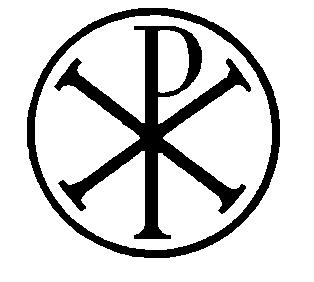
That's the chi-rho, the first two letters of Christos, which the Emperor Constantine famously had his soldiers place on their shields before the Battle of the Milvian Bridge in 313 AD after he had a vision in which God said to him: "In hoc signo vinces," or "In this sign you will be victorious." Constantine won the battle over his rival, and within a dozen years established Christianity as the official religion of the Roman Empire. All of which is to say: this has a long history as an explicitly Christian symbol.
I've read that "X-mas" came about because advertisers wanted a way to save precious space in their ads, so they began abbreviating it with the well-known Greek letter. It doesn't take Christ out of Christmas; it just shortens it.
Now, I can very well see the argument that says, "Nick, how many people are going to make that connection? Who knows Greek? If the link were so obvious, people wouldn't make this mistake! Besides which, technically it does take the word 'Christ' out of Christmas--that word ain't there no more."
Fair point. I'd prefer to use "Christmas" over "X-mas" any day. My point is to say it wasn't intended or invented as some plot to excise the Jesus from his own nativity.
I propose stressing a different point, though: how about keeping the "mas" in Christmas?
"Christmas" is short for "Christ's Mass." Yes, my non-Catholic friends, when you celebrate Christmas, you are at least nominally honoring the Catholic Mass. Thanks! This usage was more widely used in previous times. Maybe you've heard the term "Candlemas" for the feast of the Presentation, on which traditionally liturgical candles for the year are blessed?
So, whaddya say we keep the Mass in Christmas, and remember that, in the midst of the buying and the feasting and all the secular hub-bub and hoopla that fills this time of year, we are celebrating a religious holiday, a holy-day, in which we commemorate the day God Himself came forth from a virgin's womb and entered our world to save it. Let's keep the Mass in Christmas!
Except that "X-mas" doesn't take Christ out of Christmas, it just abbreviates it.
"X" in this case is not a crossing-out of something. It's the Greek letter chi, which is the first letter in the Greek word Christos [Χριστός], and you don't have to be a scholar of ancient languages to figure out that Christos means "Christ," "anointed one." Perhaps you've seem this symbol in church:
That's the chi-rho, the first two letters of Christos, which the Emperor Constantine famously had his soldiers place on their shields before the Battle of the Milvian Bridge in 313 AD after he had a vision in which God said to him: "In hoc signo vinces," or "In this sign you will be victorious." Constantine won the battle over his rival, and within a dozen years established Christianity as the official religion of the Roman Empire. All of which is to say: this has a long history as an explicitly Christian symbol.
I've read that "X-mas" came about because advertisers wanted a way to save precious space in their ads, so they began abbreviating it with the well-known Greek letter. It doesn't take Christ out of Christmas; it just shortens it.
Now, I can very well see the argument that says, "Nick, how many people are going to make that connection? Who knows Greek? If the link were so obvious, people wouldn't make this mistake! Besides which, technically it does take the word 'Christ' out of Christmas--that word ain't there no more."
Fair point. I'd prefer to use "Christmas" over "X-mas" any day. My point is to say it wasn't intended or invented as some plot to excise the Jesus from his own nativity.
I propose stressing a different point, though: how about keeping the "mas" in Christmas?
"Christmas" is short for "Christ's Mass." Yes, my non-Catholic friends, when you celebrate Christmas, you are at least nominally honoring the Catholic Mass. Thanks! This usage was more widely used in previous times. Maybe you've heard the term "Candlemas" for the feast of the Presentation, on which traditionally liturgical candles for the year are blessed?
So, whaddya say we keep the Mass in Christmas, and remember that, in the midst of the buying and the feasting and all the secular hub-bub and hoopla that fills this time of year, we are celebrating a religious holiday, a holy-day, in which we commemorate the day God Himself came forth from a virgin's womb and entered our world to save it. Let's keep the Mass in Christmas!
Sunday, December 15, 2013
Women Cardinals and Clericalism
The pope has given an interview to Italian Journalist Andrea Tornielli, mostly focusing on the meaning of Christmas, but with a few random quick questions thrown in. I found this one particularly interesting:
The clericalist assumes that one's worth within the Church is determined by the authority or power one holds in the Church. We see this mindset everywhere within the ecclesiological spectrum, whenever someone tries to turn every utterance of a priest or bishop into an infallible proclamation, binding by force of excommunication--be it ueber-traddies who denigrate receiving Communion in the hand because some saint somewhere allegedly said it was bad (even though it's an ancient practice and the Church officially allows it), to the super-lib who says anyone who doesn't adhere to their reading of every suggestion of prudential judgment from every USCCB statement on peace and justice issues is "not really Catholic" (ignoring, of course, all the conference's pro-life statements, which are just as much "peace and justice" issues as anything).
Those who agitate for women to be included among the College of Cardinals usually couch their argument in terms of power and authority: the Church needs to include women in decision-making roles; women need to have their voices heard at the highest levels; and so forth. And dig a little deeper with these folks and ask why they think women need to be placed in these positions, and 11 times out of 10, you'll hear things like: "...because then we would have the influence to change the Church's teaching on contraception/abortion/women's ordination...."
Aha! It's not about humbly serving the Church, but about substantially changing the Church. They think that might makes right, that the will determines the truth, that the teaching of the Church will be determined by the personal ideas and preferences of the governors of the Church--an even more twisted form of cuius regio, eius religio. It is the clericalist mindset that thinks the ruler makes the religion.
Pope Francis' point in this brief quotation is to slap down clericalism and uphold the dignity of every Christian and the unique calling God makes to each. You don't have to be a priest or bishop to do the work of God. Indeed, as Jeremiah 23 reminds us, the shepherd has an awful burden and responsibility before God should he lead the sheep astray--if that authority is misused, "woe unto you shepherds."
Pope Francis has said elsewhere that Mary is the model Christian, around whom the apostles were gathered at Pentecost... and she wasn't an apostle, wasn't a bishop, wasn't a cleric. She was simply herself: a disciple of Jesus Christ. Which is what we are all called to be. Let's be that.
May I ask you if the Church will have women cardinals in the future?
“I don’t know where this idea sprang from. Women in the Church must be valued not 'clericalised'. Whoever thinks of women as cardinals suffers a bit from clericalism.”Clericalism is an attitude that clerics (bishops, priests, deacons, cardinals) are somehow morally superior to the rest of the Church, that the authority they hold and the power they exercise to enact that authority are the highest goods in the Church. Clericalism is overly concerned with power, and it is a problem you find on all sides of the ecclesiological spectrum. Anyone who is more interested in using authority to put into place their ideological agenda than using it to further the Gospel and the Kingdom of God is a clericalist. Clericalism is about power, not servant leadership.
The clericalist assumes that one's worth within the Church is determined by the authority or power one holds in the Church. We see this mindset everywhere within the ecclesiological spectrum, whenever someone tries to turn every utterance of a priest or bishop into an infallible proclamation, binding by force of excommunication--be it ueber-traddies who denigrate receiving Communion in the hand because some saint somewhere allegedly said it was bad (even though it's an ancient practice and the Church officially allows it), to the super-lib who says anyone who doesn't adhere to their reading of every suggestion of prudential judgment from every USCCB statement on peace and justice issues is "not really Catholic" (ignoring, of course, all the conference's pro-life statements, which are just as much "peace and justice" issues as anything).
Those who agitate for women to be included among the College of Cardinals usually couch their argument in terms of power and authority: the Church needs to include women in decision-making roles; women need to have their voices heard at the highest levels; and so forth. And dig a little deeper with these folks and ask why they think women need to be placed in these positions, and 11 times out of 10, you'll hear things like: "...because then we would have the influence to change the Church's teaching on contraception/abortion/women's ordination...."
Aha! It's not about humbly serving the Church, but about substantially changing the Church. They think that might makes right, that the will determines the truth, that the teaching of the Church will be determined by the personal ideas and preferences of the governors of the Church--an even more twisted form of cuius regio, eius religio. It is the clericalist mindset that thinks the ruler makes the religion.
Pope Francis' point in this brief quotation is to slap down clericalism and uphold the dignity of every Christian and the unique calling God makes to each. You don't have to be a priest or bishop to do the work of God. Indeed, as Jeremiah 23 reminds us, the shepherd has an awful burden and responsibility before God should he lead the sheep astray--if that authority is misused, "woe unto you shepherds."
Pope Francis has said elsewhere that Mary is the model Christian, around whom the apostles were gathered at Pentecost... and she wasn't an apostle, wasn't a bishop, wasn't a cleric. She was simply herself: a disciple of Jesus Christ. Which is what we are all called to be. Let's be that.
Friday, December 13, 2013
The Middle of What?
Have you ever asked yourself what the "Middle Ages" are supposed to be in the middle of? The answer tells us something about our biases.
See, at the time of the Renaissance and the Enlightenment (or, as my brother likes to call it, "the Endarkenment"), European intellectuals began to rediscover knowledge from the ancient Greeks and Romans that had been lost or neglected. They came to see themselves as heirs to this classical heritage, and looked upon their predecessors of the most recent centuries as poor benighted souls who had toiled away on matters that were at best insignificant and at worst frivolous superstition. So they termed the ancients as the "classical" period or "antiquity," and themselves as "modernity" or "the Enlightenment." And what was left in between? Those ho-hum "middle ages."
Basically, it's the historiographical equivalent of "flyover country."
Yeah, never mind that medieval Christian Europe invented the hospital, the university, and the fundamentals of the scientific method (thank you, Bishop Robert Grosseteste and St. Albert the Great). Never mind that they kept alive and furthered the thought of Aristotle. Never mind that they preserved the Roman legal system which still serves as the root of European law today. We'll just ignore all that. Silly moderns. What do they know anyway?
Thursday, December 12, 2013
A Big Thanks!
If I wore a hat, I would tip it to Mark Shea for plugging my blog on his own; I may need to go get one just for the occasion.
For those of you who are new to my blog, here are a few more oldies but goodies:
--reminding journalists of a few basic principles of their craft, using the papal interview as an example
--on the proper usage of the word "tolerance"
--why rich people need our prayers
--salvation history in three minutes or less
--how words and phrases like "information," "takes one to know one," and "haters gonna hate" imply certain philosophical principles
Enjoy!
Wednesday, December 11, 2013
How Busy Are We?
We lead busy lives. We're constantly stretched and pulled by commitments here and there, by work and meetings and practices and rehearsals and events and parties and gatherings and projects. Our tools for making our lives easier, our smartphones and laptops and iPads and such, don't seem to ease our burdens, but rather multiply them. We don't finish our tasks and then relax--we make more things to do!
Let me offer a question for reflection, aimed as much at myself as anyone else:
To what degree are we busy... and to what degree are we distracted?
Yes, business and obligations and the never-empty email inbox can put a lot of demands on our time. But think: how much time during our "busy" days do we spend playing Candy Crush or Angry Birds? (Not my vice.) Watching YouTube videos of old Royal Rumble matches? (Guilty.) Binge-watching TV shows on Netflix? (Yeah, sometimes.) Writing posts for your rinky-dink blog? (Hey, wait a second!)
Now, there's nothing wrong with these activities in and of themselves. I'm not saying one is morally defective simply by doing any of these things. BUT if there are certain responsibilities we're shirking in favor of these activities, maybe we should think twice about how we spend our time?
My main candidate in mind for the neglected party is prayer. And I accuse myself first and foremost. I'm rubbish at making time for prayer during the day, and I tell myself, "Oh, I'm just so busy!" Really? Really? I managed to watch five episodes of Doctor Who in a day, but I couldn't spend fifteen minutes praying the Divine Office, or the Rosary, or just sitting in silence and opening my heart to God?
I know I can do better about this, and if this is an issue for you, dear reader, I know you can, too. All we have to do is do it. Now if you'll excuse me, I have to go trawl through my Facebook feed for an hour....
Subscribe to:
Posts (Atom)